What is happening in our Nevada prisons?
The numbers are getting worse. Despite Nevada’s prison population dropping over the last six years, the death rate has more than doubled. Even after the COVID-19 spike, it never returned to previous levels and is now rising again. Fewer people are behind bars, yet those who remain face a greater risk than ever before. The trend points in the wrong direction; declining population has not brought safer conditions. Instead, the data shows increasing risk and a system that continues to fail the people inside. These are not isolated incidents or temporary spikes; this is a pattern that has persisted year after year.
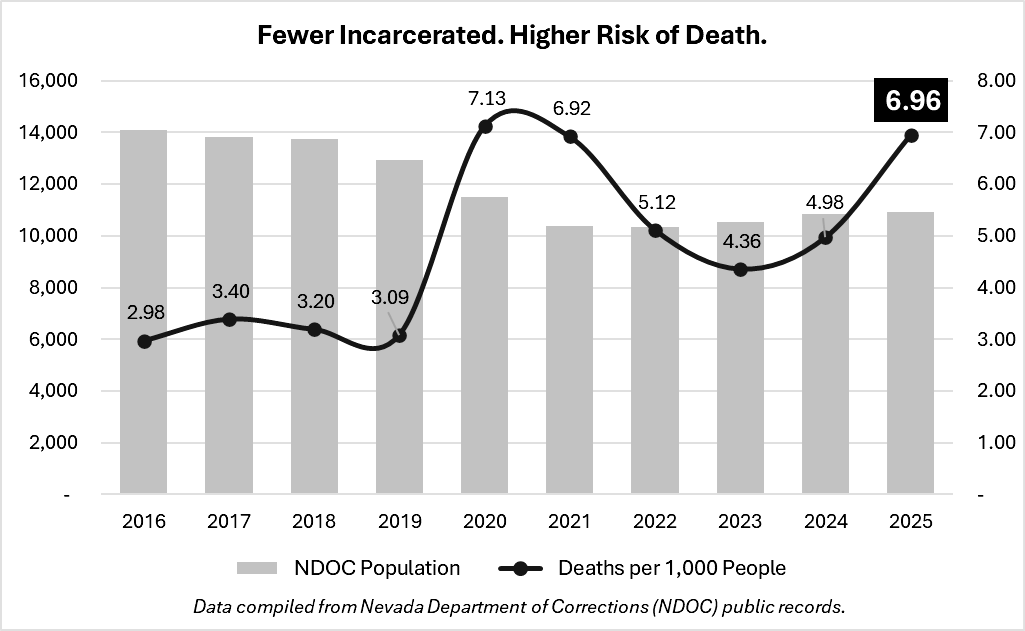
State custody carries state responsibility. NDOC officials have pointed out that prison death rates remain lower than those of the general population. Such comparisons can be misleading. Prison populations are younger than the public at large, and incarcerated people live under the total care and control of the state. They cannot choose their environment, seek outside medical care, leave unsafe conditions, or independently protect themselves from violence. The question is not only how prison death rates compare to the general population, but why deaths continue rising despite a declining prison population and the state’s responsibility to provide safe and adequate care.
What does this say about Nevada today? 76 people died in Nevada prisons in 2025. The pace of reported in-custody deaths in 2026 mirrors the deadly pace seen in 2025. This is not slowing down. Reports from inside point to rising violence, preventable medical deaths, and overdoses. Families and advocates have raised concerns about delayed or inadequate care. Safety is breaking down. Violence is not just between incarcerated people. Some have reported excessive force, intimidation, or retaliation by staff. Others describe being placed in unsafe housing due to classification decisions, including instances where individuals were housed with incompatible security levels, resulting in deaths. People are reaching out to their families saying their grievances go unanswered, that they are not being heard, and that they are afraid for their safety within a system that is supposed to protect them. Real rehabilitation is missing. Mental health care and substance use treatment remain out of reach for many, leaving people without the support they need. Without these supports, underlying issues go unaddressed, increasing the risk of harm. Changes to custody levels and the upcoming closure of minimum custody camps are expected to further reshape where and how people are housed, raising concerns about increased pressure inside higher security facilities. This is not a one-time spike. This is a pattern.
The word “Offender” is not used by accident. The NDOC uses this term, a shift introduced under former director Daniels and still used today. That wording is not neutral. It directs attention to an offense, not the person. It simplifies and reduces, making it easier to overlook conditions and outcomes that would otherwise raise concern. Language shapes perception. When people are described by a label tied to a crime, it becomes easier for the public to accept neglect, mistreatment, and even death as less urgent. This is not just language. It is framing. It shapes what members of the public are willing to accept.
Mail is not the problem. The NDOC is pushing to ban physical mail in the name of safety. The Missouri DOC implemented similar restrictions in 2022, yet deaths and drug-related issues continue to rise years later. Contraband enters prisons through multiple pathways, and focusing on mail does not address the root of the problem. What it does remove is one of the last meaningful connections people have to the outside world. Letters are not just communication. They are stability, support, and a critical link to family. Taking that away does not make prisons safer. It risks making them more dangerous.
ACCOUNTABILITY NOW!
We demand an independent investigation of all 2025–2026 deaths to determine causes and preventability, timely and adequate medical care, and an independent prison ombudsman with authority to inspect and investigate in real time. We also call for fully staffed, properly trained facilities, safe classification decisions, real access to rehabilitation, including mental health and substance use treatment, and accountability for staff misconduct. The crisis is inside the system. Action is overdue. How many more lives must be lost before things change?